POSITRON SAFETY AI:
Functional Safety for Humanoid Robots and AI-Controlled Machines
WHITE PAPER
What is POSITRON SAFETY AI? We present Synapticon’s AI-based safety architecture for humanoid robots—the first certifiable solution that simultaneously addresses mechanical instability and non-deterministic AI behavior. The new white paper “Out of the Cage: Advanced Functional Safety for Humanoids” by Dr.-Ing. Florian Weißhardt, Dr.-Ing. Tim Fröhlich, and Dieter Volpert describes the architecture in detail.
DownloadPOSITRON SAFETY AI® is Synapticon’s functional safety platform for humanoid robots and AI-controlled machines. It replaces the traditional principle that “a stopped robot is a safe robot” with three levels of safety that keep the robot under control in the event of a safety issue, rather than shutting it down.
The reason: A humanoid robot is constantly balancing itself. If a Safe Torque Off (STO) shuts down the drives, the robot loses precisely the control that keeps it upright and falls uncontrollably—in the worst-case scenario, onto a person. For industrial robots behind safety fences, a safe stop is sufficient. For humanoids, cobots, and mobile manipulators that work freely alongside people, it is not.

How does POSITRON SAFETY AI work?
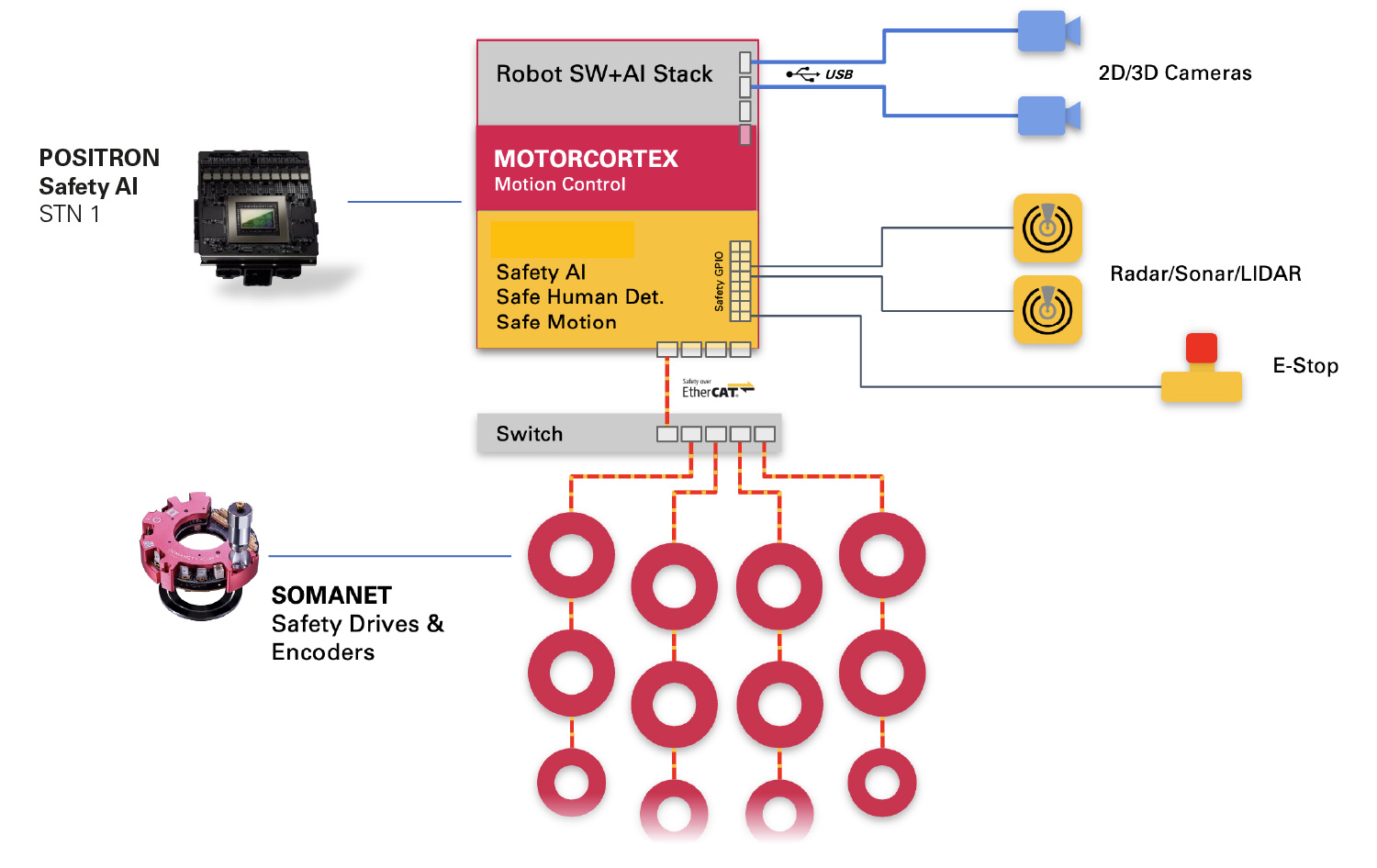
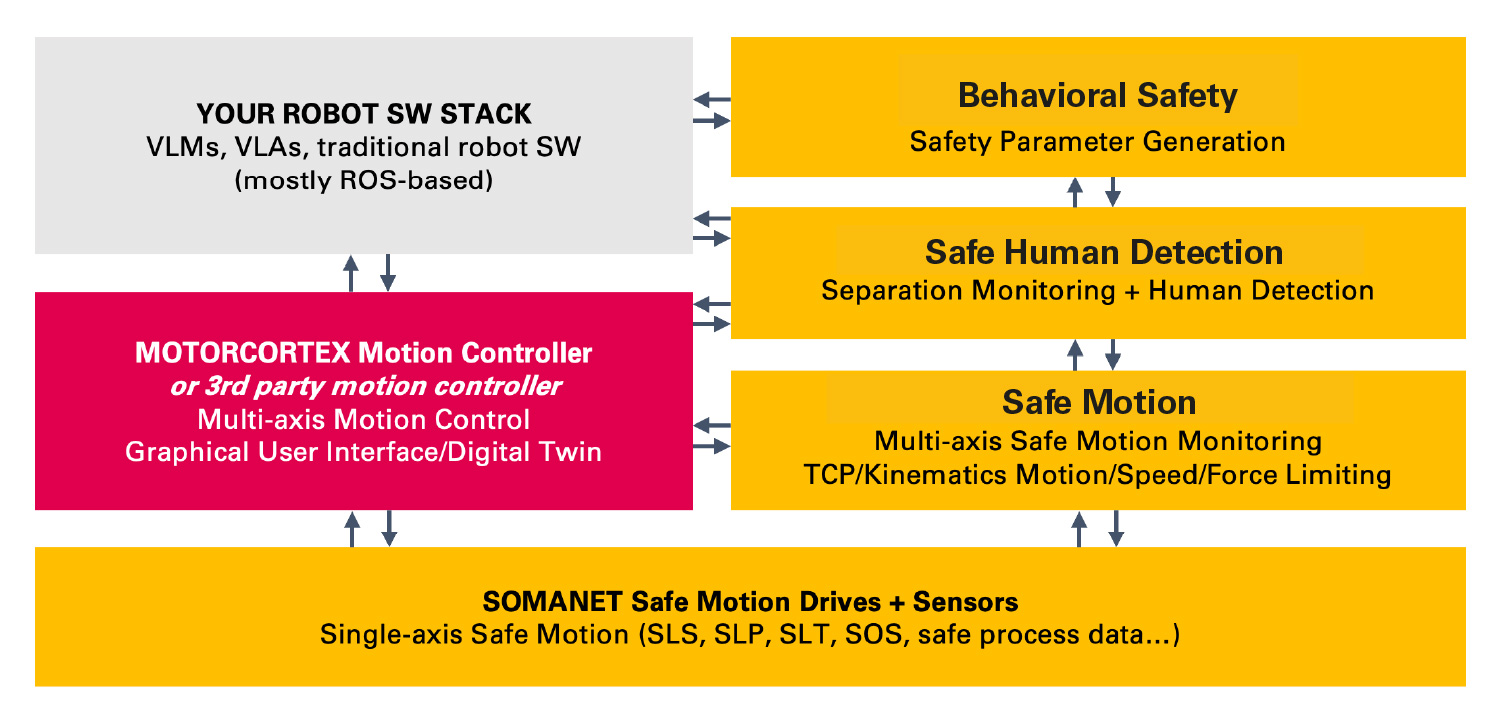
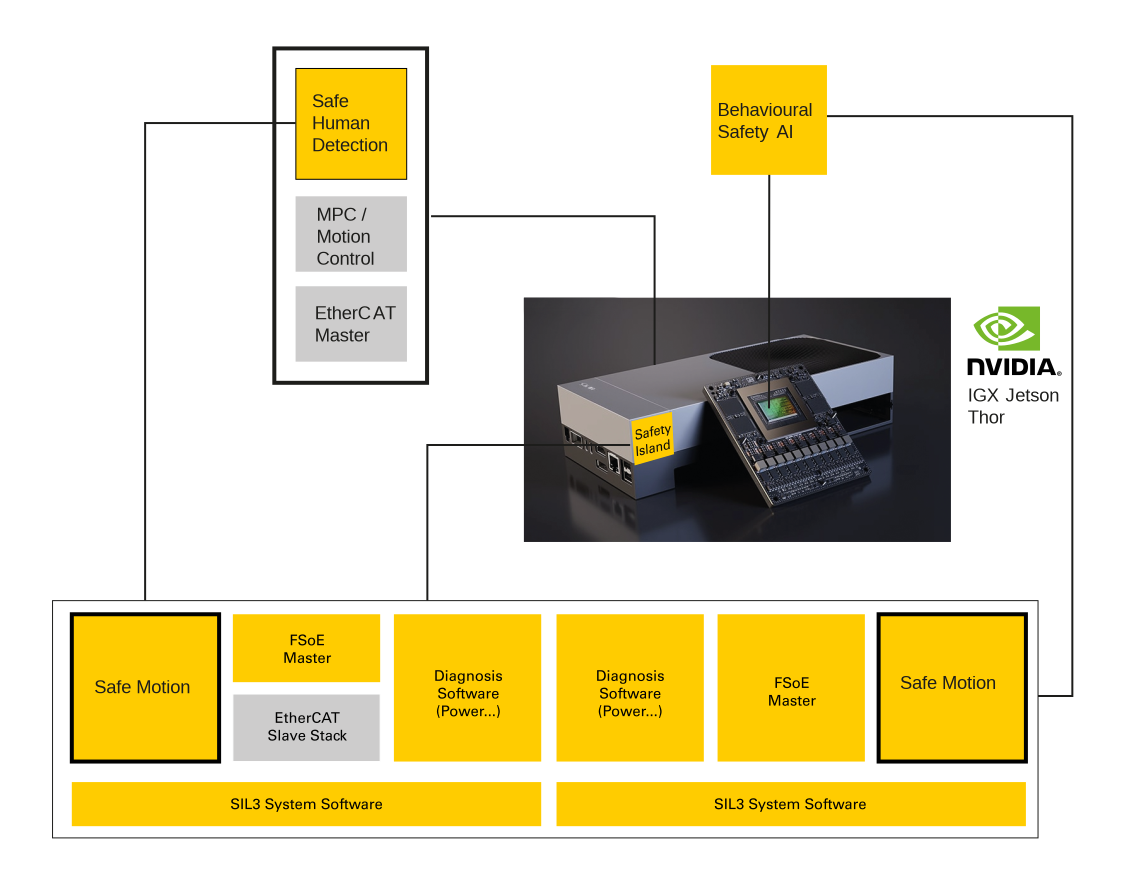
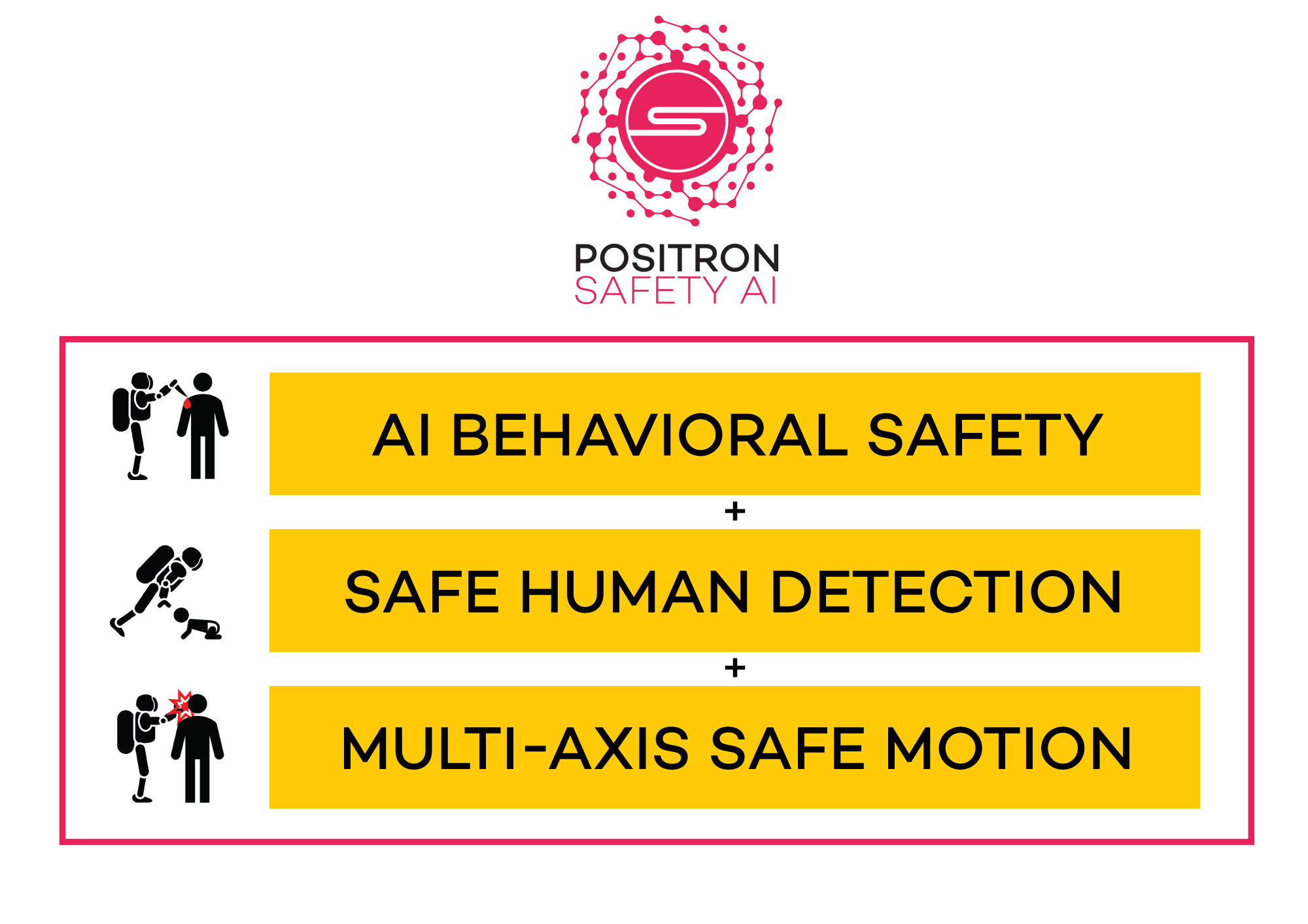
POSITRON SAFETY AI combines three safety levels into a single architecture: multi-axis safe motion, safe human detection, and safe behavioral AI. The platform thus addresses the three risks associated with modern robotics: dangerous movements, instability (such as a falling humanoid), and unpredictable decisions made by the robot’s AI. All three levels run in parallel with the robot’s regular control system.
MULTI-AXIS SAFE MOTION
What is Multi-axis Safe Motion?
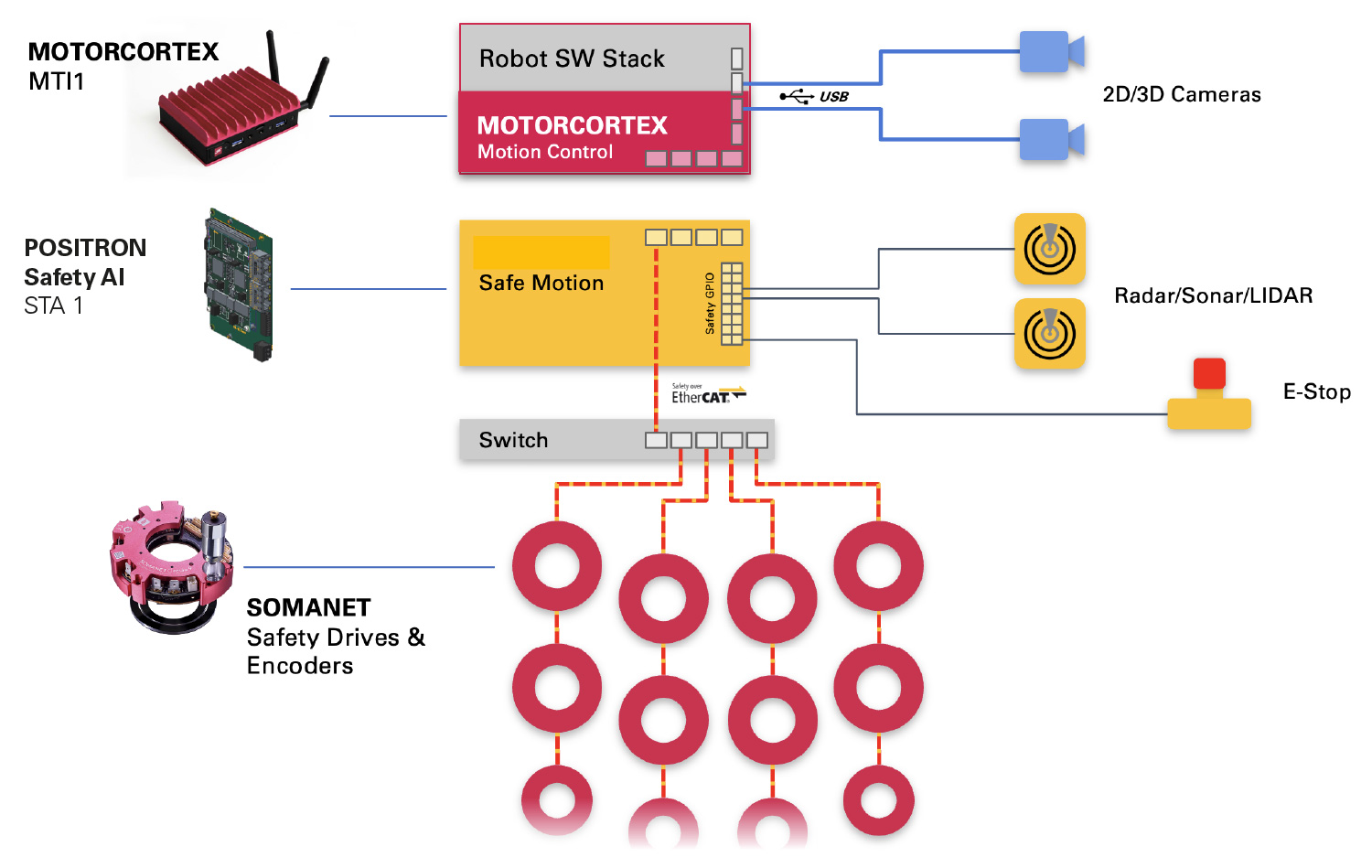
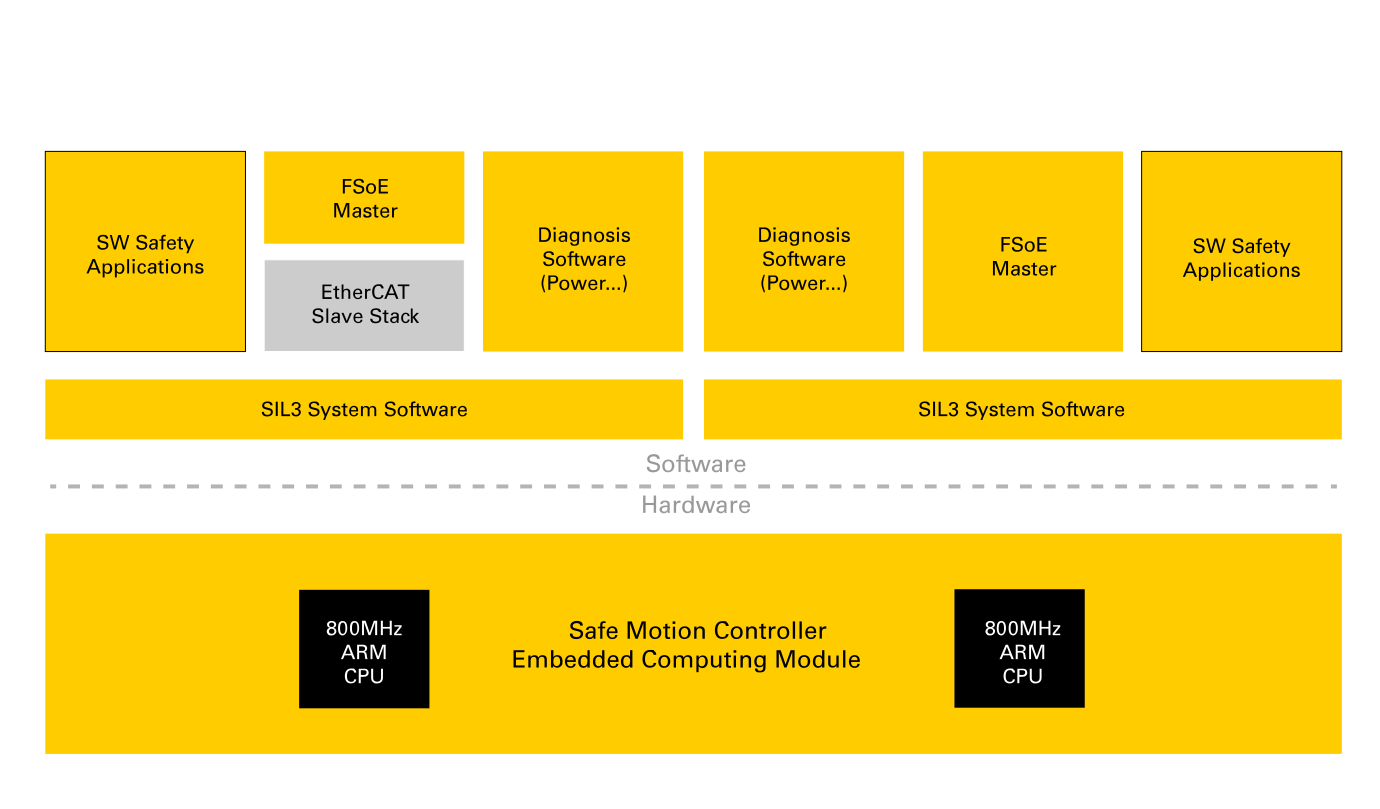
Multi-axis Safe Motion is the first level of POSITRON SAFETY AI. It continuously monitors the speed, position, and torque of all safety-relevant axes at the system level. Safety controllers available today typically monitor fewer than 10 degrees of freedom and calculate safe forward kinematics for up to 6 axes. POSITRON SAFETY AI monitors the 30+ safety-relevant axes of a humanoid robot, including safe forward kinematics.
- Reliable motion monitoring for 30+ safety-critical axes; architecture designed for 50+ degrees of freedom
- Safe forward kinematics for the entire robot
- Safe Active Damping: Controlled countertorque Instead of Locked Axles
- STA1 hardware certified to SIL3 PLe Cat. 3 (TÜV Rheinland)
Controlled Response Instead of Shutdown
In the event of a safety issue, POSITRON SAFETY AI does not shut down the drives critical to stability. The SOMANET Safety Drives and ACTILINK actuators slow the movement with controlled countertorque instead of locking the axes. This allows the robot to crouch in a controlled manner or fall in a guided, predictable way, away from people in its vicinity. Each axis functions as its own safety node and can locally prevent a dangerous movement.
SAFE HUMAN DETECTION
What is Safe Human Detection?
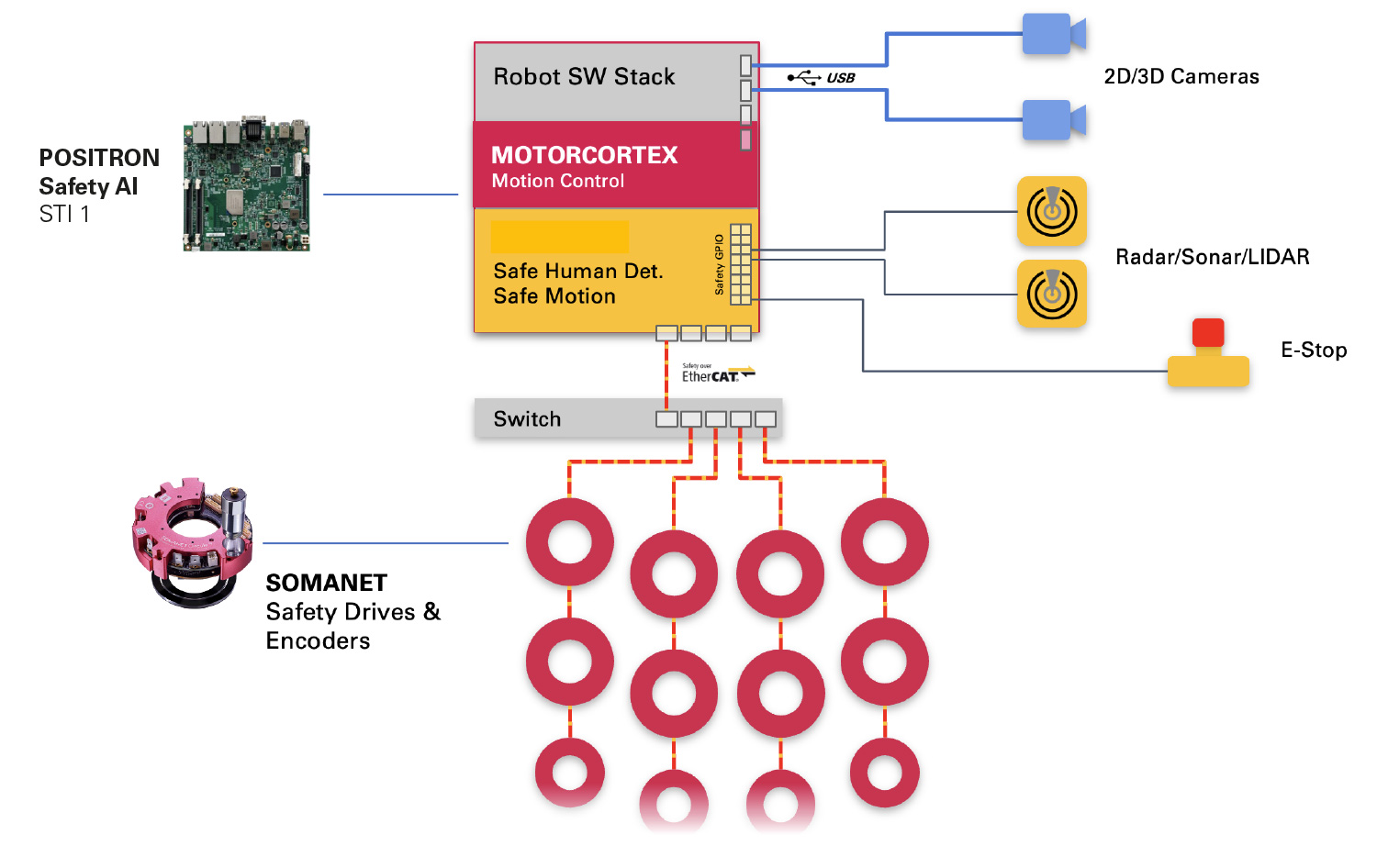
Safe Human Detection is the second plane. Laser scanners, such as those commonly used in autonomous guided vehicles, only detect a single plane just above the ground and fail to account for a humanoid’s three-dimensional workspace. Safe Human Detection therefore uses camera-based technology to detect people in 3D, from all directions, and in real time.
Detection is redundant and diverse: Two different channels analyze the camera data—for example, an AI-based channel and a non-AI-based channel. A safety measure is only deactivated if both channels consistently fail to detect a person.
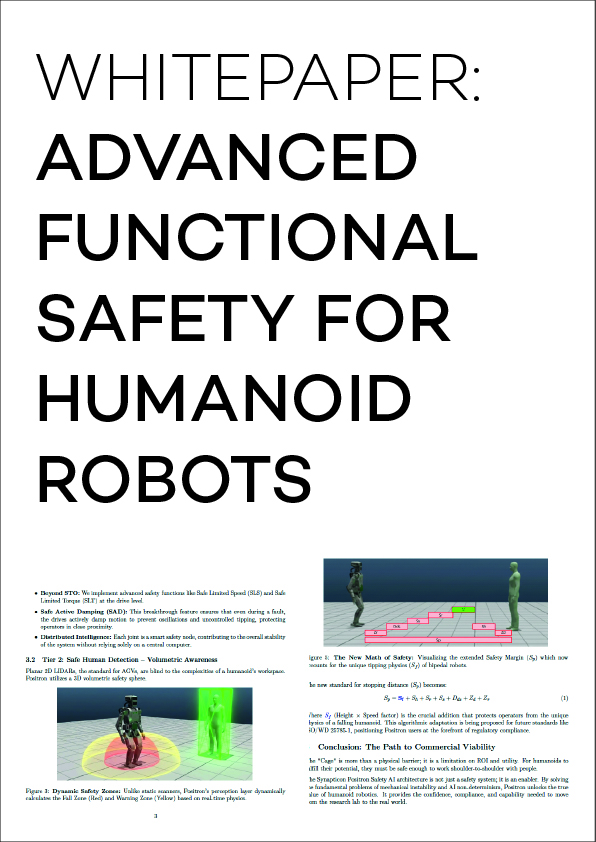
Based on the positions of the people and the robot’s real-time calculated fall zone, the Safe Motion Plane selects the appropriate response before contact occurs. The safety zones are therefore not fixed lines on the floor but adapt to the robot’s movement.
- Camera-based 3D person detection in all directions (360 degrees)
- Real-time person recognition and tracking
- Dynamic classification of objects for precise reactions
- Dynamic safety zones based on the calculated fall zone
- Redundant, diverse analysis across two channels
- Designed to comply with IEC 62998 and IEC 61496; SIL 2 PLd certification pending
Safe Human Detection is designed to comply with IEC 62998 (safety-related sensors and sensor fusion) and the IEC 61496 series of standards. Certification to SIL 2 PLd is in progress.
SAFE BEHAVIORAL AI
- Identifies potential hazards before they arise
- Detection of critical situations in real time
- Dynamic assessment of the risk situation
- Classification into safe, critical or dangerous scenarios
- Optimization for industrial applications without continuous learning
- Contributes to practical security without a certification statement; a certification path for non-learning AI is planned
What is Safe Behavioral AI?
Safe Behavioral AI is the third level. Modern humanoids are controlled by learning models, such as vision-language-action models. Their behavior is not deterministic and cannot be fully tested in advance. A traditional safety control system only considers angles, speeds, and forces, but not the context.
Safe Behavioral AI independently monitors the operational AI. Multimodal models, trained on the robot’s perspective and manipulation scenarios, evaluate the situation semantically: The same movement can be harmless or dangerous, depending on what the robot is holding and who is nearby. If a task becomes risky—such as cutting with a knife while a person is approaching—the system tightens the safety boundaries in real time.
Safe Behavioral AI complements the deterministic levels but does not replace them. There is currently no certification statement for this; a certification path for non-learning AI is planned, aligned with ISO/IEC TR 5469 and ISO/IEC TS 22440.
The separation is strict: The safety-critical level operates independently and in parallel with the AI control system. An error or a "hallucination" on the part of the AI cannot override the robot's safety systems.