
Synapticon Publishes White Paper on Safety-Certified Actuators for Humanoid Robots
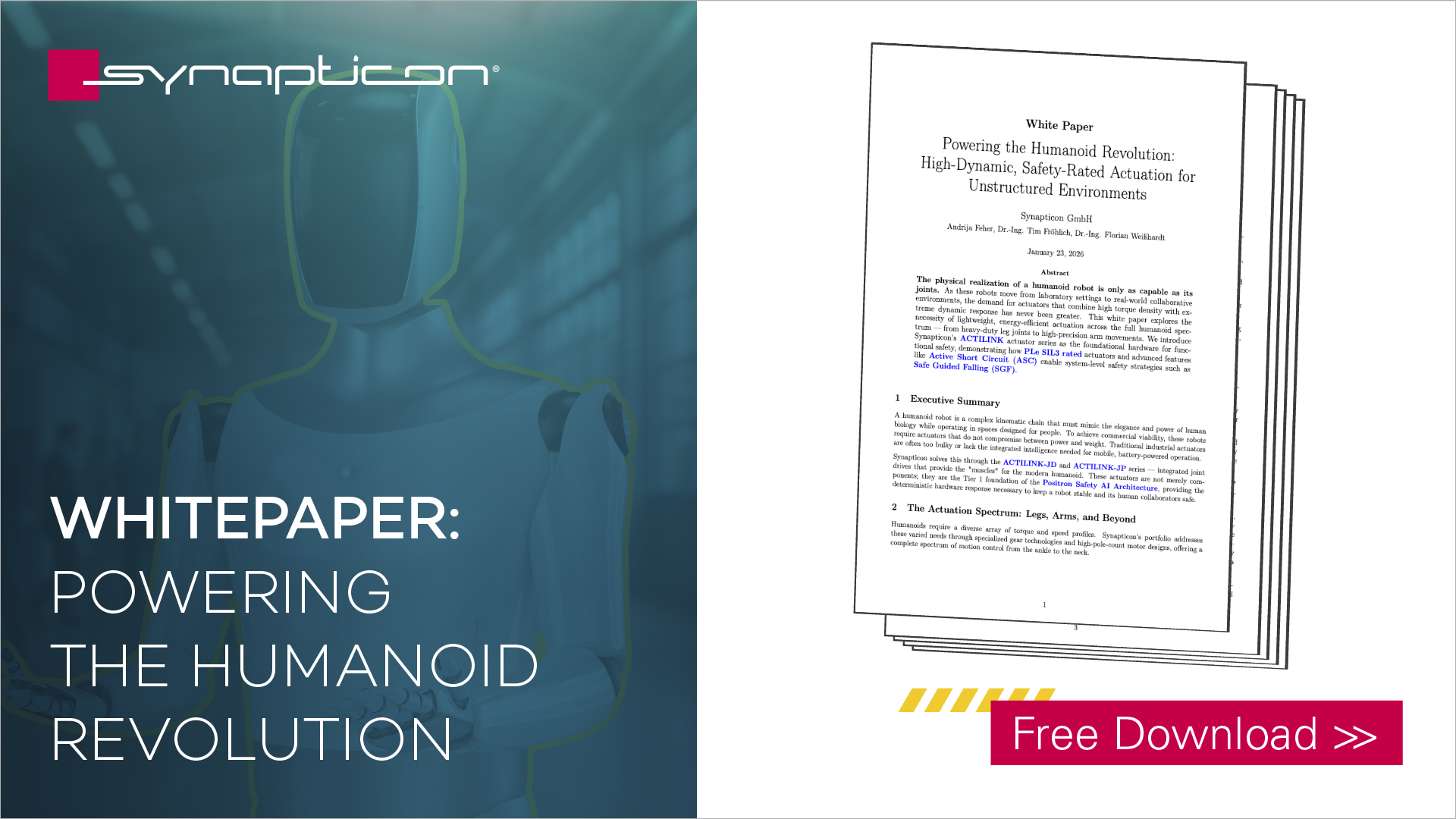
Synapticon has published a new technical white paper: “Powering the Humanoid Revolution: High-Dynamic, Safety-Rated Actuation for Unstructured Environments.” Authored by CTO Andrija Feher, Dr.-Ing. Tim Fröhlich, and Dr.-Ing. Florian Weißhardt, the document is aimed at development teams designing humanoid robots for use in human environments.
ACTUATORS AS THE PHYSICAL FOUNDATION OF AI EMBODIMENT
The central thesis of the white paper: The performance of a humanoid robot depends directly on the quality of its joints. Conventional industrial actuators are not designed for mobile, battery-powered systems that are subject to high shock loads and dynamic balance requirements. The white paper presents the ACTILINK actuator series as a dedicated solution for this application.
THE RANGE OF ACTUATORS: FROM LEGS TO ARMS
Depending on the body region, humanoid robots place fundamentally different demands on their drive systems:
- ACTILINK-JD (Dynamic Joints): For hips, knees, and ankles — planetary gearboxes, backdriveable, up to 320 Nm peak torque (JD 12 Duo). Optimized for shock absorption and energy efficiency during dynamic locomotion.
- ACTILINK-JP (Precision Joints): For arms and precision manipulation — Strain-Wave gear (Harmonic Drive), backlash-free, with an optional torque sensor and PLd certification for the "Safe Torque" function. This combination is unique in the market for Harmonic Drive actuators.
Both series are certified to Category 3, PLe, and SIL 3 —the highest functional safety level for machine components.
SAFE GUIDED FALLING: A NEW APPROACH TO SAFETY
One of the key focuses of the white paper is a conceptual problem in conventional machine safety: Safe Torque Off (STO)—the immediate shutdown of the motor power supply—is suitable for stationary industrial robots, but dangerous for a dynamically balanced humanoid. A power failure results in the loss of control authority and thus an uncontrolled fall.
Synaptic’s solution to this problem is called Active Short Circuit (ASC): The ACTILINK drives electronically short-circuit the motor windings as soon as a fault is detected. This creates an electromagnetic braking effect—known as a Safe Guided Fall (SGF). The robot descends to the ground in a guided and controlled manner instead of falling over uncontrollably. This protects the device and, more importantly, ensures the safety of people nearby.
POSITRON SAFETY AI ARCHITECTURE: THREE-LAYER SAFETY
The white paper also describes the role of ACTILINK actuators as a Tier 1 foundation of the POSITRON Safety AI Architecture:
- Tier 1 – Safe Motion: Safety-certified motion monitoring via FSoE (Fail-Safe over EtherCAT) for more than 50 degrees of freedom
- Tier 2 – Safe Human Detection: Camera-based human detection in accordance with IEC 62998
- Tier 3 – AI Behavioral Safety: A multimodal AI model for hazard detection before incidents occur
In this architecture, each actuator functions as an intelligent safety node: it monitors Safe Limited Speed (SLS) and Safe Limited Torque (SLT) in real time and provides safe position and speed data. In this way, it serves as the final safety net, ensuring a reliable response even if the AI system makes a mistake.
DOWNLOAD THE WHITE PAPER FOR FREE
The white paper is available for free download here.

